
|
 |
part 4 |
Friday 24 May 2019
Today we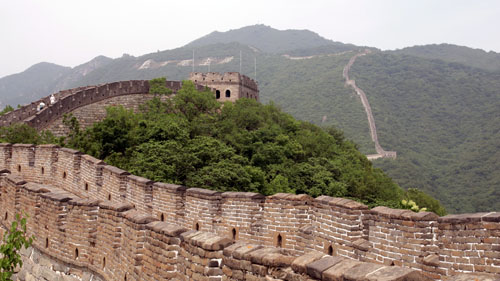 can sleep until 7.15. At half past eight we are picked up by Dahong Chen
(English name Alice), our guide for today. We have booked her through Tours
by Locals. Driver Mr Wang drives us to the Chinese wall. We
are going to the Mutianyu entrance. It is less busy here than at
Badaling, where most tourists go. It is an hour and a half drive. Upon
arrival we have to take a shuttle bus to the ground station of a cable
car. It is a climb to the cable car already, but Dahong saves us three
flights of stairs by taking the elevator for the disabled. From there we
take the cable car up to the wall. It is a wonderful experience. The wall
runs over the mountain peaks and connects watchtowers where, in ancient
times, twenty soldiers were guarding against invading Mongol barbarians.
It is quite a climb. The wall follows the mountain ridge. We
can sleep until 7.15. At half past eight we are picked up by Dahong Chen
(English name Alice), our guide for today. We have booked her through Tours
by Locals. Driver Mr Wang drives us to the Chinese wall. We
are going to the Mutianyu entrance. It is less busy here than at
Badaling, where most tourists go. It is an hour and a half drive. Upon
arrival we have to take a shuttle bus to the ground station of a cable
car. It is a climb to the cable car already, but Dahong saves us three
flights of stairs by taking the elevator for the disabled. From there we
take the cable car up to the wall. It is a wonderful experience. The wall
runs over the mountain peaks and connects watchtowers where, in ancient
times, twenty soldiers were guarding against invading Mongol barbarians.
It is quite a climb. The wall follows the mountain ridge. We walk back and forth to the nearby watchtowers, but the heat prevents from
too many climbs. It is beautiful, nonetheless. After the wall we go down
again and Dahong picks a restaurant for us. We have a nice lunch. Pork and
dumplings. Yummy.
walk back and forth to the nearby watchtowers, but the heat prevents from
too many climbs. It is beautiful, nonetheless. After the wall we go down
again and Dahong picks a restaurant for us. We have a nice lunch. Pork and
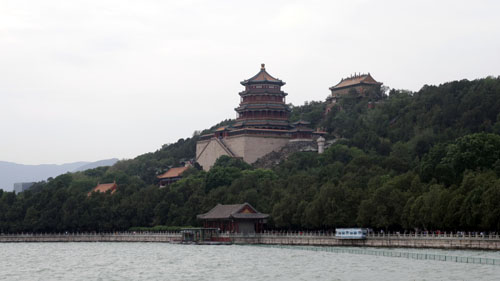
dumplings. Yummy.After dinner, Mr. Wang is standing ready with his beautiful Nissan to drive us to the Emperor's Summer Palace northwest of Beijing. That's a long drive. There is a lot of traffic and it takes almost two hours before we get there. The summer palace is beautifully situated on an artificial lake and consists of several buildings and temples, located on or on the Longevity Mountain. There is also a 700-meter-long gallery along the shores of the lake. It is very busy there. The gallery is not only special because of its length, but also because of the hand-painted representations on it. More than 800 different images of flowers, animals, landscapes and mythical figures. We walk past the Summer Palace and leave the gardens
 at the north exit, where Mr. Wang is waiting again. Then we drive into the
city and an hour later we are back at the Cote
Cour hotel. Tired, but an experience richer for it. Dahong was very
caring during the entire trip. Helped constantly, held the camera, got ice
creams and who knows what more. Awesome.
at the north exit, where Mr. Wang is waiting again. Then we drive into the
city and an hour later we are back at the Cote
Cour hotel. Tired, but an experience richer for it. Dahong was very
caring during the entire trip. Helped constantly, held the camera, got ice
creams and who knows what more. Awesome.In the evening we eat again at DanDong. The chic restaurant, where we have already eaten Peking duck. We now choose Wagyu beef and some other goodies. The bill is higher this time.
Weather: 32 degrees and slightly cloudy with sunny periods.
Zaterdag 25 May 2019
Today we visit the Temple of Heaven, for centuries the spiritual centre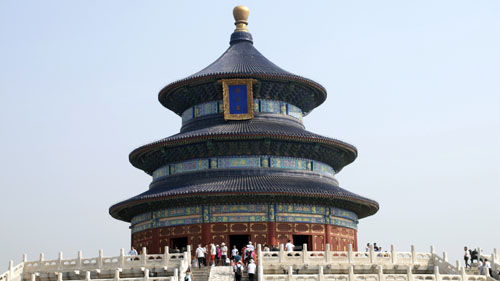 of
the Chinese empire and of course – from a Chinese perspective - the whole
world. The temple was built in the early 15th century. It was renovated in
the 18th century, but by then the imperial treasury was really empty. The
temple was occupied by Anglo-French troops during the second opium war.
During the boxer uprising by an alliance of 8 foreign powers. The temple
suffered great damage. Nothing of that is visible now. The temple is
located in a large park, where the Chinese are busy with Tai Chi
exercises, dancing, music and singing. Admission must be paid for the
temples. The blue colors of the three-layer temple are beautiful.
of
the Chinese empire and of course – from a Chinese perspective - the whole
world. The temple was built in the early 15th century. It was renovated in
the 18th century, but by then the imperial treasury was really empty. The
temple was occupied by Anglo-French troops during the second opium war.
During the boxer uprising by an alliance of 8 foreign powers. The temple
suffered great damage. Nothing of that is visible now. The temple is
located in a large park, where the Chinese are busy with Tai Chi
exercises, dancing, music and singing. Admission must be paid for the
temples. The blue colors of the three-layer temple are beautiful.After the temple we travel by metro to the , where the 2008 Olympic games took place. Best known and most impressive is the National Stadium, the Bird's Nest, by the Swiss architects Herzog & De Meuron with creative inspiration by Ai Wei Wei. We can get into it. The tour is in Chinese, but even without
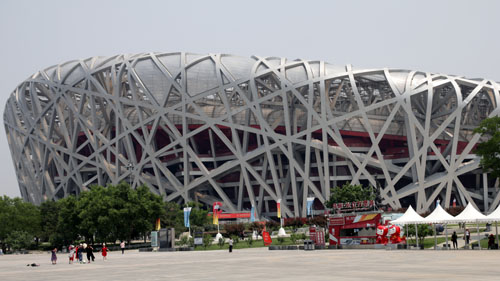 explanation it is clear what is there to see. The stadium is big, but you
still have the impression that you are close to the field. The special
thing is of course the concrete structure on the outside to which the
stadium owes its nickname. Opposite the stadium is the Swimming Stadium,
the Water Cube. During the winter games in 2022, it will be renamed the
Ice Cube for ice hockey and figure skating.
explanation it is clear what is there to see. The stadium is big, but you
still have the impression that you are close to the field. The special
thing is of course the concrete structure on the outside to which the
stadium owes its nickname. Opposite the stadium is the Swimming Stadium,
the Water Cube. During the winter games in 2022, it will be renamed the
Ice Cube for ice hockey and figure skating.We have lunch at the Burger King at the stadium. In the meantime the thermometer has risen to 35 degrees around 1 pm and it is time to go back to the hotel. In the evening we eat at the hotel.
Zondag 26 May 2019
It's raining today. We have planned to go to the 798 Art District in the
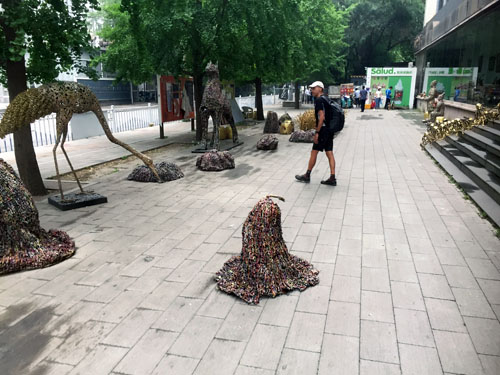 Northeast of the city. An artists' district has developed on the site of
an abandoned electronics factory, once built here by the East Germans for
the communist brother nation. The government was fearful of a cultural
sanctuary and initially wanted to demolish it, but gentrification took a
big flight and now it is completely within the framework that the powers
that be are happy with. Unfortunately it is raining cats and dogs and
there are also thunderstorms. We look at a number of boutiques and
galleries and make a few purchases. But the rain makes it unpleasant. We
take the bus and the metro back into the city and go to the , the
historical museum of Beijing. A beautiful building with a cylinder and a
cube, in which the historical exhibition has been set up. Unfortunately
there is nothing to eat in the entire building. There is a canteen, but it
is closed on Sunday lunchtime. How is it possible! We look around. The
exhibition is interesting, especially the excavations and the Buddha
statues.
Northeast of the city. An artists' district has developed on the site of
an abandoned electronics factory, once built here by the East Germans for
the communist brother nation. The government was fearful of a cultural
sanctuary and initially wanted to demolish it, but gentrification took a
big flight and now it is completely within the framework that the powers
that be are happy with. Unfortunately it is raining cats and dogs and
there are also thunderstorms. We look at a number of boutiques and
galleries and make a few purchases. But the rain makes it unpleasant. We
take the bus and the metro back into the city and go to the , the
historical museum of Beijing. A beautiful building with a cylinder and a
cube, in which the historical exhibition has been set up. Unfortunately
there is nothing to eat in the entire building. There is a canteen, but it
is closed on Sunday lunchtime. How is it possible! We look around. The
exhibition is interesting, especially the excavations and the Buddha
statues. 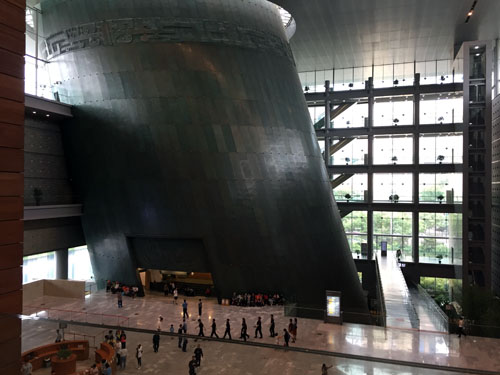 The
political history has been cleaned up somewha. The Guomindang and Chang
Kai Chek are not mentioned at all. What is special is that a parallel
timeline has been set out on the outside with Western history, both
political and cultural.
The
political history has been cleaned up somewha. The Guomindang and Chang
Kai Chek are not mentioned at all. What is special is that a parallel
timeline has been set out on the outside with Western history, both
political and cultural.After almost two hours we are done and it has stopped raining outside. We still want to see the big lakes in the center, but apparently we got off the metro at the wrong stop. We are not getting there and the road we want to go is strictly guarded by plain clothes police (recognizable by the white shirt and umbrella) and some in uniform as well. We even have to show our passport. Without having seen a lake, we go back to the hotel. In the evening we eat at the hotel.
Weather: heavy thunderstorms in the morning, cloudy in the afternoon. 23 degrees
maandag 27 May 2019
We It's raining today. We have planned to go to the 798 Art District in the Northeast of the city. An artists' district has developed on the site of an abandoned electronics factory, once built here by the East Germans for the communist brother nation. The government was fearful of a cultural sanctuary and initially wanted to demolish it, but gentrification took a big flight and now it is completely within the framework that the powers that be are happy with. Unfortunately it is raining cats and dogs and there are also thunderstorms. We look at a number of boutiques and galleries and make a few purchases. But the rain makes it unpleasant. We take the bus and the metro back into the city and go to the Capital Museum, the historical museum of Beijing. A beautiful building with a cylinder and a cube, in which the historical exhibition has been set up. Unfortunately there is nothing to eat in the entire building. There is a canteen, but it is closed on Sunday lunchtime. How is it possible! We look around. The exhibition is interesting, especially the excavations and the Buddha statues. The political history has been cleaned up somewha. The Guomindang and Chang Kai Chek are not mentioned at all. What is special is that a parallel timeline has been set out on the outside with Western history, both political and cultural.
After almost two hours we are done and it has stopped raining outside. We still want to see the big lakes in the center, but apparently we got off the metro at the wrong stop. We are not getting there and the road we want to go is strictly guarded by plain clothes police (recognizable by the white shirt and umbrella) and some in uniform as well. We even have to show our passport. Without having seen a lake, we go back to the hotel. In the evening we eat at the hotel.
Weather: heavy thunderstorms in the morning, cloudy in the afternoon. 23 degrees
Monday 27 May 2019
We get up early because we fly to Shanghai at 10 am. At 6.15 we are outside and walk
 to
the bus stop. One stop by bus and then by metro from Dongsi station with
two transfers to the Airport Express at Dongchimen station. Then it takes
more than half an hour to the airport. At 8 o'clock we are at the Beijing
Capitol Airport. We drop off the luggage - we have already checked
in online - and go through a thorough check. All equipment must be taken
out of the bag. We have breakfast at Starbucks and also at Costa, because
a number of items are sold out at Starbucks. Then we go to the gate for
our flight with China
Eastern Airlines (a Skyteam partner). Checking in starts 45 minutes
late. Once on the plane, we have to wait a long time before we are allowed
onto the runway and only at half past eleven, we go
to
the bus stop. One stop by bus and then by metro from Dongsi station with
two transfers to the Airport Express at Dongchimen station. Then it takes
more than half an hour to the airport. At 8 o'clock we are at the Beijing
Capitol Airport. We drop off the luggage - we have already checked
in online - and go through a thorough check. All equipment must be taken
out of the bag. We have breakfast at Starbucks and also at Costa, because
a number of items are sold out at Starbucks. Then we go to the gate for
our flight with China
Eastern Airlines (a Skyteam partner). Checking in starts 45 minutes
late. Once on the plane, we have to wait a long time before we are allowed
onto the runway and only at half past eleven, we go 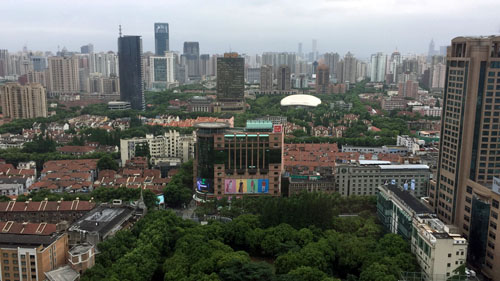 up
in the air, instead of a quarter past ten. We arrive at Shanghai Hanqiao,
the older of the city's two airports, around half past one. It all goes
smoothly there. The luggage comes through quickly and the metro ride takes
less than 20 minutes. It is 3 pm when we fall on our bed at the Okura
Garden Hotel. Nice luxury.
up
in the air, instead of a quarter past ten. We arrive at Shanghai Hanqiao,
the older of the city's two airports, around half past one. It all goes
smoothly there. The luggage comes through quickly and the metro ride takes
less than 20 minutes. It is 3 pm when we fall on our bed at the Okura
Garden Hotel. Nice luxury.An hour later we drink a cocktail in the Skybar and later eat at Guyi Hunan in a nearby shopping mall (IAMP). The food is tasty and spicy. I eat Bull Frog and Erik breaded eggs, stir-fried cauliflower and rice. Afterwards coffee at Starbucks and later in the evening a drink in the Skybar.
Weather: cloudy, light rain. 29 degrees.dinsdag 28 mei 2019
Tuesday 28 May 2019
 We take the extensive buffet breakfast in the Rose Café of the hotel. Then
we drink coffee at Starbucks. We buy a chip card for the metro at the
metro station on which we load a credit. That is easier than always having
to buy a ticket for each ride. It is called a Shanghai Public
Transportation Card, available at most metro stations. The card costs 100
Yuan, of which 60 Yuan travel credit. On departure you can reclaim the
deposit and the remaining credit, but we are sure to forget that again.
Then we take the metro to Lujiazui, where the big skyscrapers are. We want
to go to the top of the Shanghai
Tower, but the entrance to the Observatory is not that easy to
find. The staff is also not very helpful. In the end we find it. The view
is beautiful on the Huangpu River and the Bund across the river. Most of
the high-rise buildings are concentrated in Pudong, where we are now, but
there are also many tall buildings on the other side, but not in the same
league as the Shanghai Tower, which at 632 meters is the second tallest
building in the world
We take the extensive buffet breakfast in the Rose Café of the hotel. Then
we drink coffee at Starbucks. We buy a chip card for the metro at the
metro station on which we load a credit. That is easier than always having
to buy a ticket for each ride. It is called a Shanghai Public
Transportation Card, available at most metro stations. The card costs 100
Yuan, of which 60 Yuan travel credit. On departure you can reclaim the
deposit and the remaining credit, but we are sure to forget that again.
Then we take the metro to Lujiazui, where the big skyscrapers are. We want
to go to the top of the Shanghai
Tower, but the entrance to the Observatory is not that easy to
find. The staff is also not very helpful. In the end we find it. The view
is beautiful on the Huangpu River and the Bund across the river. Most of
the high-rise buildings are concentrated in Pudong, where we are now, but
there are also many tall buildings on the other side, but not in the same
league as the Shanghai Tower, which at 632 meters is the second tallest
building in the world 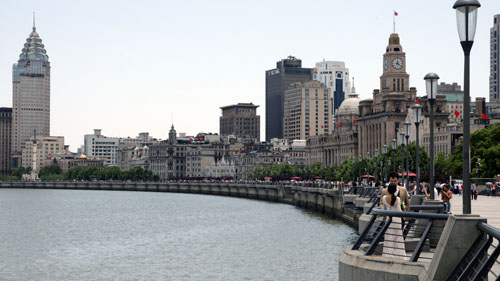 and
the tallest in China. The viewing platform is on the 118th floor at a
height of 545 meters.
and
the tallest in China. The viewing platform is on the 118th floor at a
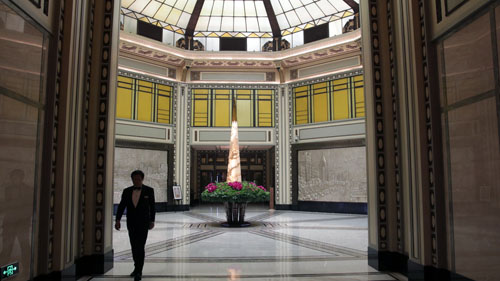
height of 545 meters. After the tower we go to the Bund. The Bund is an English / Indian term from Bunding that refers to the embanking of a muddy shore. The Bund is the east bank of the Huangpu River with mainly British-colonial buildings. From the end of the 19th century until the arrival of the Japanese in 1941, Shanghai was a Western colony. And that is clearly visible here. The boulevard is wide and offers a spectacular view of the skyscrapers on Pudong. On the Bund is also the Fairmount Peace Hotel from 1926 in Art Deco style designed by Palmer and Turner. Famous guests were George Marshall, Charlie Chaplin and Bernard Shaw. The interior has been completely restored and it is freely accessible. A popular photo shoot location. We drink tea with a pastry.
Then back to the hotel. Opposite the hotel on Maoming South Street there are man
 y
tailors who tailor costumes to measure. I order a suit from David Street
Tailors. Every limb and body part is measured and various choices have to
be made about buttons, splits, lapels and what not. A shirt will also be
made. I have to come back tomorrow for a fitting.
y
tailors who tailor costumes to measure. I order a suit from David Street
Tailors. Every limb and body part is measured and various choices have to
be made about buttons, splits, lapels and what not. A shirt will also be
made. I have to come back tomorrow for a fitting.At the end of the afternoon we go to the . Here, mainly older residents of Shanghai enjoy the green surroundings and play cards, debate, sport and walk.
We eat dinner at Din Tai fung in the IAMP shopping center in the evening. The menu is Taiwanese street food. Deliciously prepared and tasty. We take wonton dumplings with pork, fried rice with beef and lettuce and tomatoes. We are taking a chestnut dumping and something else that we cannot quite determine.
After dinner we drink coffee at Seesaw coffee, a local espresso bar. We round off the day with a cocktail in the sky bar
Weather: 27 degrees and sunny
Wednesday 29 May 2019
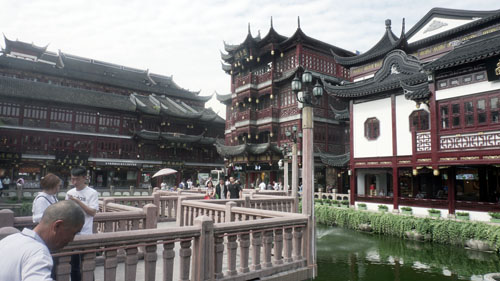
After breakfast we travel by metro to Yu Garden. The garden with
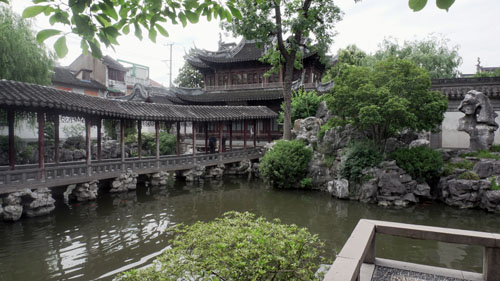 that name is just a few minutes away by bike. It was constructed during
the Ming Dynasty by a senior government official in honor of his father.
It is a large collection of traditional houses, temples, ponds, courtyards
and large stones with holes in it, which have a mystical meaning for the
Chinese. The bridges with the rectangular turns are a striking feature.
This is because, according to the Chinese, evil spirits cannot make
rectangular turns. We are early and it is still relatively quiet. Part of
the complex can only be visited for a fee and that is also the nicest
part. Around the garden is a large bazaar with shops that mainly sell
tourist junk and make a lot of noise. The garden is well worth a visit.
that name is just a few minutes away by bike. It was constructed during
the Ming Dynasty by a senior government official in honor of his father.
It is a large collection of traditional houses, temples, ponds, courtyards
and large stones with holes in it, which have a mystical meaning for the
Chinese. The bridges with the rectangular turns are a striking feature.
This is because, according to the Chinese, evil spirits cannot make
rectangular turns. We are early and it is still relatively quiet. Part of
the complex can only be visited for a fee and that is also the nicest
part. Around the garden is a large bazaar with shops that mainly sell
tourist junk and make a lot of noise. The garden is well worth a visit.From the garden we go by bike to the Huangpu River for a river boat tour. We buy tickets at a kind of tourist office, where nobody speaks English. As I don't have enough cash in my pocket, I have to go to an ATM. The desk clerk walks with me to point out the ATM and then guides to the terminal, so that we still catch the 11 o'clock boat. The boat is relatively calm and we have enough space on the upper deck to take pictures of the banks. Pudong with its skyscrapers on one side and the Bund with its colonial buildings on the other. It's beautiful. We are back after 50 minutes. We take the metro to
 the
hotel and immediately go to the tailor to fit my suit. There are a lot
pins and even more measuring by as many as three people. It will be a nice
suit, that's for sure. It will be ready tomorrow at 5 pm. And of course
the shirt and tie are thrown in as well.
the
hotel and immediately go to the tailor to fit my suit. There are a lot
pins and even more measuring by as many as three people. It will be a nice
suit, that's for sure. It will be ready tomorrow at 5 pm. And of course
the shirt and tie are thrown in as well.Around 5 pm we go to a restaurant on the Bund. It have chosen M on the Bund. It is located on the 7th floor of a colonial building with beautiful views of Pudong and the Bund. It's been around for 20 years. The food and the service match the view. We enjoy oysters and salad as starters and then cod and Australian beef as main courses. For dessert we take the Grand Dessert for two with a dessert wine (Orange Muscat; Australia). Coffee with cookies after. Then we go down to the Bund, to take pictures and videos. We are approached by a curious young Chinese man for a chat. Then we walk with a huge crowd of people on East Nanjing Road to the metro station. The police are doing their best keeping the pedestrian flows apart. It is that busy.
Weather: 28 degrees, cloudy with sunny periods
Thursday 30 May 2019
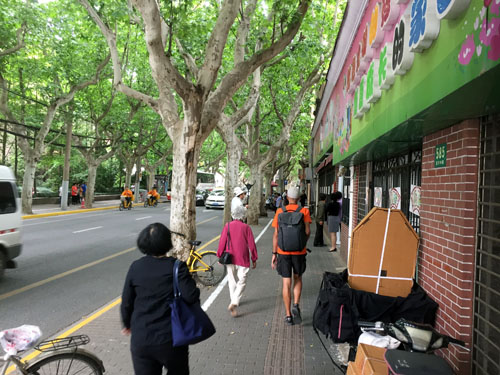
We take the mobike to the former . This area fell into French hands
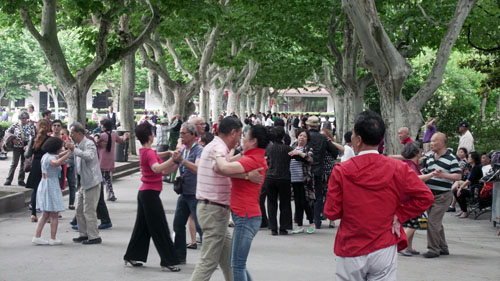 in
1849 and remained so until 1943 when Germany forced the Vichy regime to
surrender it to Japan. We drink coffee at Café
de Volcan in a typical street for this neighborhood. Low-rise
buildings, shops and small-scale eateries. The cafe also serves the local
gay scene. We walk via the Fuxin Road (French street) with the French
plane trees to the Fuxin Park (French Park). Here it is very busy with
especially older Shanghainese, who sing, dance, exercise and do exercises.
It is very nice to see how people enjoy themselves together. Some groups
get dance lessons, others are already very accomplished and dance in
formation. It is a cacophony, because each group has brought its own
amplified music. There are also music groups that play saxophone, clarinet
and trumpet to a music tape.
in
1849 and remained so until 1943 when Germany forced the Vichy regime to
surrender it to Japan. We drink coffee at Café
de Volcan in a typical street for this neighborhood. Low-rise
buildings, shops and small-scale eateries. The cafe also serves the local
gay scene. We walk via the Fuxin Road (French street) with the French
plane trees to the Fuxin Park (French Park). Here it is very busy with
especially older Shanghainese, who sing, dance, exercise and do exercises.
It is very nice to see how people enjoy themselves together. Some groups
get dance lessons, others are already very accomplished and dance in
formation. It is a cacophony, because each group has brought its own
amplified music. There are also music groups that play saxophone, clarinet
and trumpet to a music tape.After the park we cycle to
 Xiantiandi. This is a very chic shopping area with expensive stores
including DJI, the
drone makers, but also from Tesla and a Chinese brand sports car, Qiantu.
Ironically, here is also the building where the first meeting of the
Communist Party of China took place in 1921. We take the metro back to the
hotel. We have lunch at the hotel in the Café Rose and have a rest.
Xiantiandi. This is a very chic shopping area with expensive stores
including DJI, the
drone makers, but also from Tesla and a Chinese brand sports car, Qiantu.
Ironically, here is also the building where the first meeting of the
Communist Party of China took place in 1921. We take the metro back to the
hotel. We have lunch at the hotel in the Café Rose and have a rest.Later in the afternoon we cycle to Tianzifang. That is about fifteen minutes of cycling. This is a jumble of alleys north of the Taikang Lu. In those alleys we find countless shops with food, souvenirs, but also crafts and art. Also a number of nice cafes and restaurants. We wander around a bit and settle down at a Tibetan bar, where we drink a Tibetan beer. Erik attracts a lot of interest again because of his height.
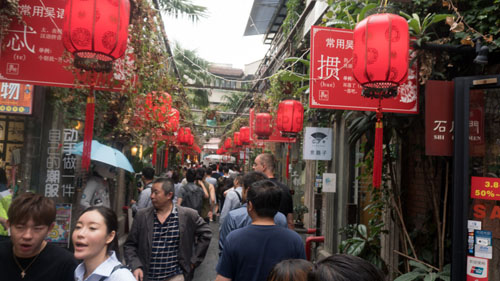 We
are also approached by a retired geography teacher for a chat. He collects
euro coins and finally asks if we have new coins with are new king
Willem-Alexander. Unfortunately we have nothing in our pocket. We go back
by metro to the hotel and pick up my suit at David Street Tailors. It fits
like a glove. The shirt too. I choose a matching tie. Then back to the
hotel.
We
are also approached by a retired geography teacher for a chat. He collects
euro coins and finally asks if we have new coins with are new king
Willem-Alexander. Unfortunately we have nothing in our pocket. We go back
by metro to the hotel and pick up my suit at David Street Tailors. It fits
like a glove. The shirt too. I choose a matching tie. Then back to the
hotel.In the evening we eat again at the Taiwanese restaurant Din Tai Fung in the IAMP shopping center. Afterwards we drink coffee at SeeSaw coffee next door. We pack our suitcase and in the evening we drink another cocktail in the Skybar of the Okura hotel.
Weather: slightly cloudy and warm. 27 degrees. A bit of rain in the afternoon
Vrijdag 31 May 2019
After breakfast we pay at the reception and take metro line 1 to People's Square and then line 2 to Pudong. Especially in line 2 the trains are filled
 to
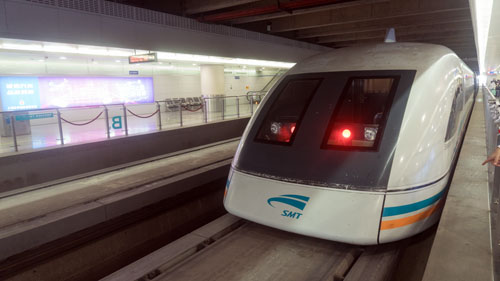
the brim. We get off at Laoyang, where we take the Maglev
(Magnetic Levitation). That is the magnetic gliding track, which will
transport us over the last 18 km to the airport in 7 minutes. With a top
speed of 431 km / h we are racing along the route. An experience! It is
the only commercially operated magnetic levitation track in the world so
far - and since 2002.
to
the brim. We get off at Laoyang, where we take the Maglev
(Magnetic Levitation). That is the magnetic gliding track, which will
transport us over the last 18 km to the airport in 7 minutes. With a top
speed of 431 km / h we are racing along the route. An experience! It is
the only commercially operated magnetic levitation track in the world so
far - and since 2002.At the airport we drop off our luggage at the KLM counter and we go through a security check again. This is very thorough. Everything has to be unpacked and scanned. Batteries are particularly of interest. Then we look for the gate. Due to a renovation, we have to use a waiting room, which is intended for small flights that leave off terminal and have to be reached by bus. Now passengers for two intercontinental flights have to wait here, which means that the space is overcrowded. Not very pleasant. There is nothing to buy in the way of drink for food; for that I have to go upstairs again to the large departure hall.
We get in 40 minutes late and therefore also leave Shanghai too late: around 1am instead of 12.15. Eventually we land at Amsterdam Airport Schiphol with a 10-minute delay after a flight of around 11 hours. We arrive at Schiphol on 6.11pm and have the 6.53 train to Rotterdam. We are home around 7.45.
Weather: sunny 25 degrees in Shanghai. Sunny 23 degrees in the Netherlands.
